
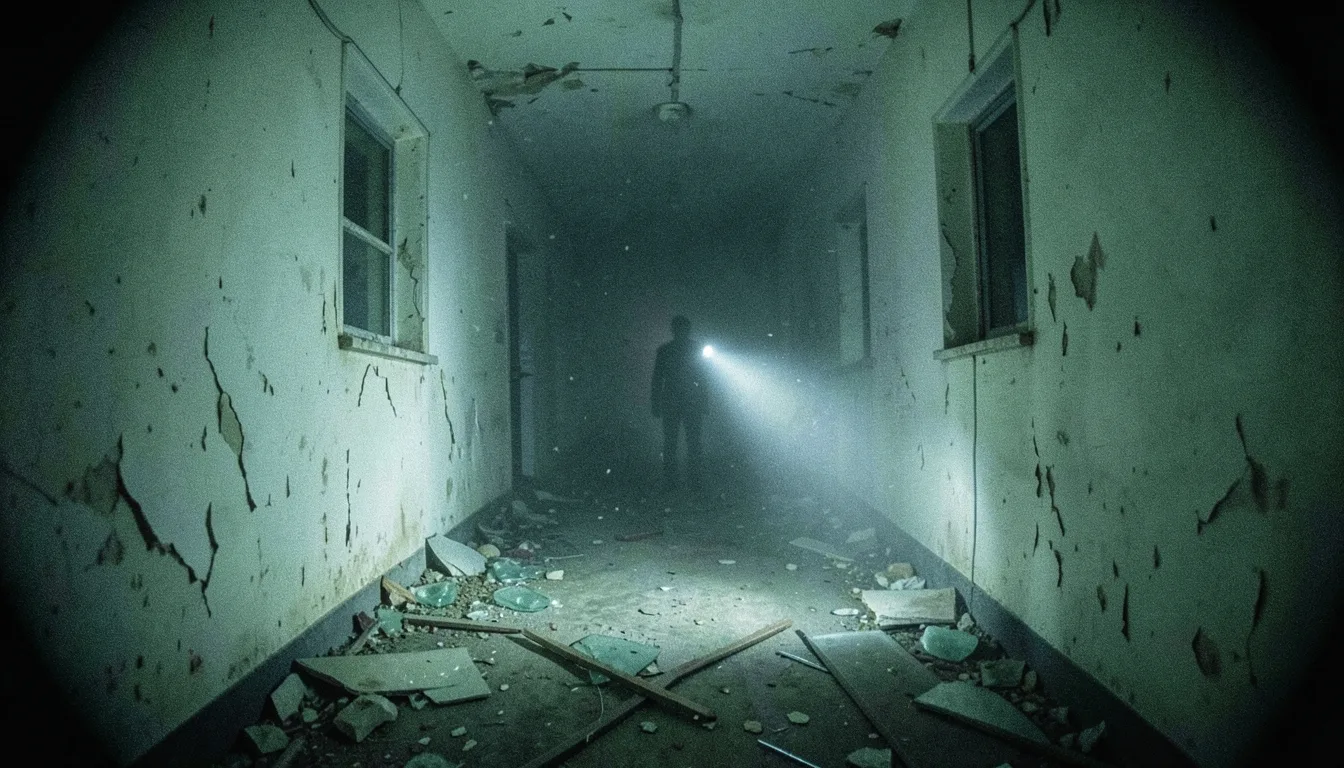
 ◆ AI-generated image
Agramonte Sanatorium: History and Myths of Moncayo
🖌 The cover picture is an AI-made illustration, not a photo from the investigation. The case, the places and the testimonies are real.
Automatic translation of the Spanish original, reviewed by the group when possible.
The Agramonte sanatorium in Zaragoza was once a luxury hotel and a tuberculosis hospital; today, it is a haven of ruins, myths, and dark legends.
Welcome to another journey into those corners where history and legend entwine to curdle our blood. Today we explore the Agramonte Sanatorium, an icon of mystery and medical tragedy in Spain. Amidst ruins and tuberculosis lore, the shadows of the past seem to come alive once more. Listen closely, because the night in Moncayo is never entirely alone.
From Luxury Hotel to Refuge of Death
Picture the foothills of Moncayo, in the province of Zaragoza. Up there, amid the mist and dense pine forests, it all began with a promise of luxury and distinction. The Agramonte Sanatorium wasn't built to house pain, but rather to welcome high society seeking the pure mountain air. It was an ambitious hotel project conceived for rest and recreation. But history had very different plans in store for those stone walls. The outbreak of an unrelenting health crisis completely shattered the investors' golden dream. It was the year 1938 when the building underwent a forced conversion. That elegant hotel transformed overnight into a tuberculosis sanatorium. The urgency of the moment forced them to clear out the luxury rooms and fill them with terminal patients. To understand the scale of that drama, we must look at the historical context of the era. Tuberculosis was an implacable disease, a silent scourge that decimated the population mercilessly and without distinction. There was no effective cure, and the only medical hope lay in absolute isolation, prolonged rest, and pure-air cures at high altitudes. Moncayo offered precisely that: perfect isolation, but also a freezing solitude. And so Agramonte left behind its brief life of opulence to become a haven of death. Within those corridors, a dark chapter began to be written, marked by constant suffering and loss.
Quarantine, Isolation, and Final Closure
Imagine the absolute silence of the Moncayo foothills, in Zaragoza, broken only by the creaking of old wood and the relentless lashing of the wind up high. Up there, in the Natural Park near Tarazona, daily life in the Agramonte sanatorium was defined by the strictest isolation. The tuberculosis sufferers admitted to its facilities knew that this lonely spot operated as a veritable dead-end trap. The daily suffering of the patients played out across endless corridors and rooms where the medicine of the day could barely offer temporary relief. Many of them faced the disease in utter loneliness, far from their families, and deaths within the hospital wards were a silent constant. Those walls witnessed endless agonies while winter snow blocked access to the building.
As the decades passed, the country's health situation changed radically thanks to the advancement of antibiotics and modern medicine against tuberculosis. The former anti-tuberculosis center, repurposed after its initial stint as a luxury hotel, became completely obsolete for modern medical demands. Finally, in 1978, the doors of Agramonte were shut for good, sealing the place's fate. What had once been a desperate refuge against disease was left to its fate in the middle of the Aragonese mountains, slowly devoured by dampness and oblivion. Nature began to reclaim what was hers as the building took on that grim visage we know today.
Modern Myth and Dark Tourism
When the doors of the Agramonte sanatorium closed forever in nineteen seventy-eight, Moncayo reclaimed what was hers. The building, perched on the mountain foothills near Tarazona, began a rapid process of decay that turned it into a hulking mass of chewed-up concrete, hazardous to anyone daring to venture inside. Nature carved a path through the corridors where tuberculosis patients once prayed, creating a pitch-perfect setting for fantasy and terror. Over the years, institutional neglect gave way to the modern phenomenon of dark tourism. Agramonte left its sad medical reality behind to become the undisputed epicenter of urban legends in Aragón and one of the most feared spots in all of Spain.
Media attention wasn't far behind. Mystery shows like Cuarto Milenio set their sights on these lonely ruins, drawing a steady tide of sightseers, self-proclaimed paranormal investigators, and thrill-seekers. According to the accounts of those who have crossed its threshold by night, the place holds more than just memories of death. Visitors claim to have captured impossible EVPs (electronic voice phenomena), spotted wandering shadows with no master, and sensed unseen presences keeping watch from the gaps in the collapsed stairwells. The sanatorium's fame grew, fueled by every news report and every video shared online. Nowadays, the old hotel turned lazaretto is an unmissable stop on any national mystery map.
The Explanations
At this point, it's time to deflate the legends a bit and look at the Agramonte Sanatorium from the cold, strict perspective of science. What really lies behind the EVPs, the shadows, and that constant feeling of being watched in the dark? Acoustic physics has plenty to say about ruined buildings like this one. Long corridors, crumbling walls, and stairwells create genuine resonance chambers where the Moncayo wind is distorted in impossible ways. A creak of old wood from yards away, a cold draft slipping through a glassless frame, or a small falling stone transform, as they travel through these nooks and crannies, into whispers and laments that sound human.
Add to this the psychological factor and sheer suggestion. Whoever crosses the threshold of Agramonte is already preconditioned by internet videos, mystery shows, and horror stories that have circulated for decades. The human brain, exposed to darkness, cold, and the very real danger of unstable structures, triggers its defense mechanisms and starts seeing shapes where there are only shadows cast by the moon. Science calls this pareidolia: our mind's tendency to recognize familiar patterns, such as faces or human silhouettes, in ambiguous and chaotic visual stimuli. The shadows shifting out of the corner of your eye are, the vast majority of the time, tricks of the light and your own adrenaline playing against you. Thus, the rational explanation of architectural decay stands opposed to that irrepressible fascination with the paranormal that draws sightseers and ghost hunters every weekend. The sanatorium doesn't need wandering souls to terrify; its own history of pain, coupled with the very real danger of collapse and the echo of the wind at night, is a tailor-made engine for our imagination.
Head over to ghostbeers dot es to share your darkest cases with us, and don't forget to subscribe to the iVoox channel so you never miss a mystery.
— End of report. Draw your own conclusions.
Explainable or unexplainable?
Vote to see what everyone else thinks. No sign-up.
Have you been there?
Nobody has told their story about this place yet. Will you be the first?
Más expedientes de lugares abandonados
 EXP. 2020-022▶ Podcast
Ghost & Beers: Agramonte
A sanatorium at the foot of Moncayo, tackled with the uncompromising grit of the heavyweight champions of mystery. An investigation carried out in 2019, finally released for your viewing pleasure in 2020. We're back...
 EXP. 2026-064◆ AI illustration
The macabre labyrinth of Chicago
A three‑storey building with blind corridors, deadly traps and a bespoke gas chamber that terrified the United States.
 EXP. 2026-063◆ AI illustration
The thirteen shadows of the São Paulo tower
A fire devoured a skyscraper in Brasil, leaving behind an impossible photograph and EVPs that nobody has been able to explain.